
11 Vintage Old Rare Lesney Matchbox Cars Trucks Mint Some Boxed Colectors Dream
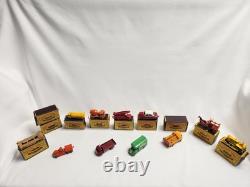
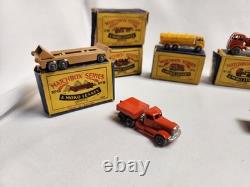
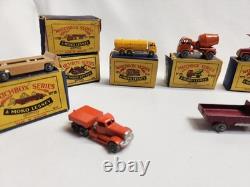
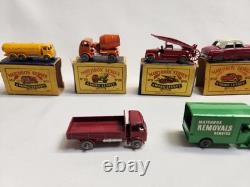
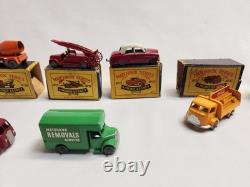
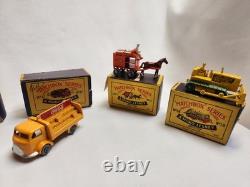
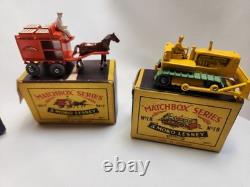
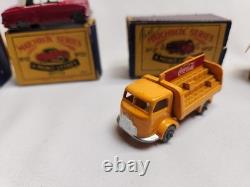
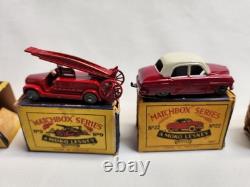
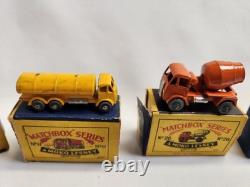
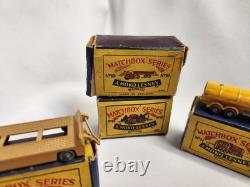
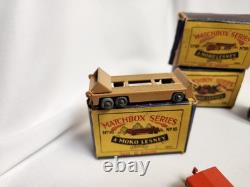
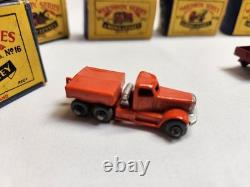
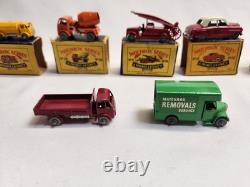
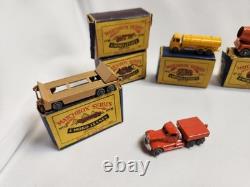
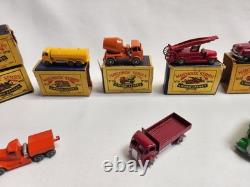
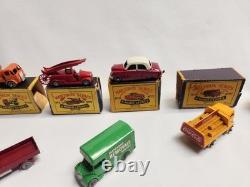
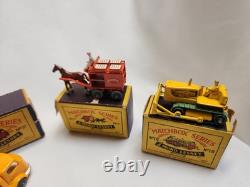
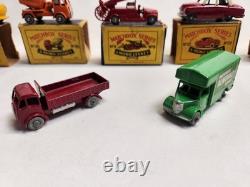
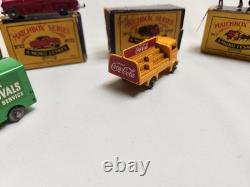
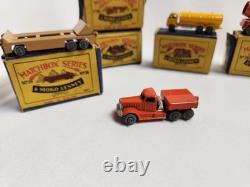
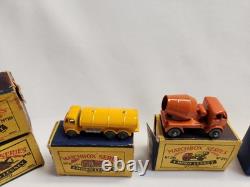
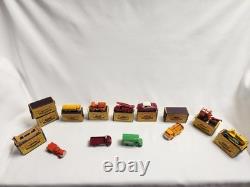

11 VINTAGE OLD RARE LESNEY MATCHBOX CARS TRUCKS EXTREMELY CLEAN MINT SOME BOXED. This is an absolutely amazing find. PLEASE SEE PHOTOS AND VIDEO AND YOU WILL SEE HOW CLEAN EACH OF THESE 11 LESNEY MATCHBOXES ARE!
A COLLECTOR'S DREAM FIND! List of Vintage RARE Lesney Matchboxes listed for sale representing the years 1955 - 1968. 7 Horse Drawn Fire Engine. 15 Diamond T Prime Mover.
37 Karrier Bantam Coca-Cola Truck. 8 Caterpillar Tractor with green rubber tracks. Plus two (2) empty boxes - No. 7 Horse Drawn Fire Engine - has a box. 7 Horse Drawn Fire Engine is a classic piece of die-cast history, originally released in 1954 as part of the early 11-model "1-75" series.It is a scale model based on a Victorian-era horse-drawn steamer. The model is notably smaller than later Matchbox releases, reflecting the "Matchbox" name-designed to fit inside a standard box of matches. Typically painted in a vibrant crimson red. Features two white or off-white horses attached to the front.
The casting includes a boiler, steam pipes, and a driver's seat. Usually features a small, integrated metal driver figure. Early versions featured metal wheels (MW), while later runs moved to black plastic wheels (BPW). Because this was one of the earliest models, there are several variations that collectors look for.
Some rare early versions have gold paint hand-applied to the boiler and fittings. The transition from metal to plastic wheels marks different eras of production. The "Type A" script box is the most coveted by collectors. This model was inspired by the 1905 London Fire Brigade steam pumper. It was eventually replaced in the Matchbox line in 1959 by the No.
7 Ford Anglia, making the Horse Drawn Fire Engine a strictly "early era" Lesney piece. It remains a favorite for enthusiasts because it captures the transition from horse-drawn utility vehicles to the motorized era that Lesney would go on to document so thoroughly.9 Dennis Fire Engine - has a box. 9 Dennis Fire Engine is a classic of the early "1-75 series, " representing a transition from the very first large-scale toys to the iconic miniature line. It is highly sought after by collectors for its various casting evolutions.
Released in the mid-1950s, the model is a simplified but charming representation of the British-made Dennis fire trucks used during that era. Die-cast metal, finished in a vibrant fire-engine red. Roughly 1:100, measuring approximately 55mm to 60mm in length. Features a separate, detachable metal ladder (usually gold or silver-painted) that slides into a groove on the top of the vehicle. Includes cast-in details like the front grille, side lockers, and hose reels.
Early versions lacked windows (as was standard for the time). Key Variations & Collector Value. The value of a No. 9 Dennis Fire Engine often depends on which "version" it is, specifically regarding the wheels and the ladder style. Metal wheels (painted or unpainted).Black or Grey plastic wheels. Cast metal, often with a "curled" end. Straight metal or early plastic versions.
Often features hand-painted gold on the grille. Less common or simplified in later runs. Often unpainted metal with "No 9" stamp. This is the most frequently lost or broken part.
9 with its original metal ladder intact is significantly more valuable than one without. These models were toys first. Look for "edge wear" (paint loss on the corners). Early metal wheels can suffer from "zinc pest" (crumbling), while plastic wheels should be checked for flat spots. A "Moko Lesney" era box in good condition can often be worth more than the car itself. It's a quintessential piece of British toy history-simple, sturdy, and a perfect example of why Lesney became a household name. 11 ERF Tanker - has a box. 11 ERF Tanker is a classic piece of die-cast history, representing the transition from early "Regular Wheels" models into the more modern era of toy manufacturing. Produced primarily in the late 1950s and early 1960s, it remains a favorite for collectors due to its distinct variants. 11 ERF Petrol Tanker was released to replace the earlier No. It is based on the British ERF (Edwin Richard Foden) "KV" type chassis, easily recognizable by its rounded, streamlined cab design. Because Lesney frequently updated their molds and color schemes, several versions of the No. Usually painted red, though rare yellow variants exist. Most commonly found in yellow, though early versions were red. Early models featured "Esso" decals; later versions often had "Esso" or "BP" printed directly or via stickers. Metal wheels (MW) on the earliest releases, transitioning to grey plastic wheels (GPW) and eventually black plastic wheels (BPW).Early versions had no windows (hollow cab), while later "C" castings included green-tinted windows. There is a highly sought-after version with a gold-painted tanker body, originally released as part of a gift set. On these vintage models, the condition of the "Esso" or "BP" decals significantly impacts the value. Like most early Matchbox, it was designed to fit into the standard small matchbox-sized packaging rather than adhering to a strict uniform scale across the line.
If you are looking at a specific one, check the wheels-metal wheels usually indicate a production date closer to. While black plastic wheels suggest the mid. 15 Diamond T Prime Mover - no box.Is a classic of the "Regular Wheels" era, representing a rugged, heavy-duty military transport vehicle. It was first introduced in. And saw several variations before being replaced in the 1960s. Approximately 1:100 (Small scale to fit the standard Matchbox).
The Diamond T Prime Mover is best known for its "army green" appearance, modeled after the real-world 6x4 tactical truck used during and after WWII. Almost exclusively found in olive drab / military green. Early versions featured metal wheels ; later runs transitioned to black plastic wheels. This model was produced before Lesney introduced plastic windows, so it features an open cab with no glazing. The bed of the truck typically includes a towing hook intended to pull the No. 15 was a foundational piece in the Matchbox military range. Collectors often look for specific casting differences, such as. The original 1955 release, which is slightly smaller and lacks some of the finer underside detailing. Some very early versions featured a silver star decal on the hood, though many survived without them or lost them over time. Because it was built as a "Prime Mover, " it is most frequently paired with the. To create a complete military convoy.Finding one with an intact rear hook and original paint is the primary goal for most vintage die-cast enthusiasts. 16 Transporter Trailer - has a box. 16 Case Tractor Transporter is a classic of the "Superney" era, first introduced in the late 1960s.
It was designed as a specialized trailer to carry the No. 39 Clipper or various tractor models from the Matchbox line.
Usually found in a vibrant orange or red-orange paint finish. Features a grey or black plastic base, though earlier versions may have metal components. Originally released with black plastic wheels (BPW), though later versions appeared with Superfast thin wheels during the 1970 transition. The standout feature is the rear loading ramp, which can be lowered to allow small tractors or vehicles to be "driven" onto the trailer. It features a standard drawbar eyelet at the front, designed to hook onto the tow bar of trucks like the No.
10 Pipe Truck or the No. Often features "Case" or "16" decals on the sides, though these are prone to wear on played-with models.
The value of this model often depends on the hydraulic piston detail (usually molded in plastic) and the condition of the rear ramp hinge, which is the most common point of failure. If you are looking at a "Superfast" version with thin, flashy wheels, it is generally considered a later, more common production run compared to the original regular wheel versions.17 Bedford Removals Van - no box. 17 Bedford Removals Van is a quintessential piece of die-cast history, representing the transition from early "Regular Wheels" to more detailed models. First introduced in 1958, it underwent several variations that are now highly scrutinized by collectors. The Bedford Removals Van was part of the 1-75 series and was designed to look like a typical British moving truck of the mid-20th century.
Based on the Bedford S-Type (commonly known as the "Big Bedford") with a large "luton" box body extending over the cab. Most commonly found in light blue, green, or maroon. Features the text "MATCHBOX REMOVALS SERVICE" on both sides. Early versions used decals (transfers), while later versions used paper labels.
Evolution moved from metal wheels (very early) to Grey Plastic Wheels (GPW) and eventually Black Plastic Wheels (BPW). If you are looking at a specific model, these details determine its rarity and value. This was actually a different casting-the Bedford Removals Van (Small). It was shorter, had no windows, and was painted blue. The version most people recognize.
It is larger than the 17a and features the "Matchbox Removals Service" branding. While light blue is the standard for the 17b, there was a production run in dark green that is significantly more valuable to collectors. Look at the front of the cab.
Some versions have a hand-painted silver grille and headlights, while others were left unpainted (body color). Collectors often look for'silvering' or peeling. A 17b with original metal wheels or a dark green body is considered a'holy grail' find for this specific number.
20 ERF Stake Truck - no box. 20 ERF Stake Truck is a classic of the early "1-75 series, " representing the transition from simple toys to the highly detailed die-cast models that made the brand famous. Produced primarily in the late 1950s and early 1960s, it captures the rugged aesthetic of post-war British transport. There were two distinct versions of the No. 20 ERF Stake Truck, which collectors often differentiate by their size and color. This model was significantly smaller, painted in maroon, and featured a metal stake body. This version was scaled up and is the one most commonly associated with the number. It was released in a bright blue or dark blue finish. Based on the ERF 64G, featuring the distinct "sun visor" cab shape.A flatbed "stake" truck, used for hauling timber, crates, or livestock. Early versions had silver or black metal wheels; later versions moved to grey or black plastic. The baseplate usually features the text: Matchbox Series No. 20 - ERF Stake Truck - Made in England by Lesney. The ERF Stake Truck is prized for its simplicity and the era it represents.
When evaluating a model, collectors look for specific markers. Some versions of the blue 20b featured silver trim on the grille and headlights.
Minor casting variations exist in the height and thickness of the stake sides. Original "B" or "C" style Moko Lesney boxes (yellow with line-drawing illustrations) significantly increase the value, often more than the truck itself.
If your truck is dark red/maroon, it is the early 20a (roughly 48mm long). If it is blue and feels slightly heavier, it is the more common 20b.22 Vauxhall Cresta - has a box. 22 Vauxhall Cresta is a classic of the early "Golden Age" of Matchbox cars. It's a perfect example of how Lesney captured the sleek, space-age influence of 1950s British automotive design in a tiny, 1:75 scale die-cast model. Here is a breakdown of the two distinct versions produced under the No.
The "a" casting modeled the Vauxhall Cresta E Series. It is easily identified by its rounded, somewhat "bulbous" 1950s styling.Usually found in a dark red (maroon) or a tan/copper finish. There is a rare white over dark red two-tone version that is highly sought after by collectors. In 1958, Lesney updated the model to reflect the new, trendier Vauxhall Cresta PA, which featured iconic tailfins and a wrap-around rear window inspired by American Chevrolets of the era.
Maroon body with a cream roof. Pale pink body with a blue or grey roof. Started with grey plastic wheels (GPW), moved to silver plastic, and eventually black plastic wheels (BPW).
Early versions had no windows; later "b" models introduced green-tinted or clear plastic glazing. Later models have green/clear windows. If you are looking at one today, check the axles. The 22a almost always has crimped axles, while the 22b transitioned into rounded axles. The most valuable versions are generally the two-tone 22a or the pink-and-blue 22b with its original "Moko" script box. 26 ERF Cement Mixer - has a box. 26 ERF Cement Mixer is a classic of the early "regular wheels" era, first introduced in 1956. It is a fantastic example of the intricate die-cast work Lesney was known for during the mid-fifties. Here is a breakdown of the model's features and variations. The model features a heavy die-cast metal cab and chassis, based on the real-world ERF 68G 8-wheeled truck. The most recognizable feature is the large, orange-painted metal barrel mounted on the rear. In the original "A" version, this barrel is stationary and does not rotate. The most common version features an orange barrel paired with a silver or grey cab. It originally featured metal wheels, which were later transitioned to black plastic wheels (BPW) and occasionally grey plastic wheels (GPW) toward the end of its production run. 26 went through two distinct iterations before being replaced by other models. Sometimes found with "Ready Mix" or silver trim.Many people confuse the No. 26 with the later No. 44 GMC Refrigerator Truck or the No. 3 Truck, but the No.
26 is unique for its 8-wheel configuration and its rigid, non-mechanical barrel. When inspecting this model, look for the casting of the silver grille. Because the barrel is cast metal and heavy, the rear axles are often slightly bent on well-played-with versions. A "Moko" Lesney box (the type with the blue and yellow "matchbox" design) significantly increases the value, especially if the end flaps are intact. It's a quintessential piece of British toy history-simple, sturdy, and instantly recognizable to anyone who collected Matchbox in the 1950s.
37 Karrier Bantam Coca-Cola Truck - has a box. 37 Karrier Bantam Coca-Cola Truck is one of the most iconic "Regular Wheels" models from the early Matchbox era. Produced in the UK between 1957 and 1966, it features a distinct yellow-orange body and represents a classic piece of mid-century advertising. There are two primary versions of this model (37a and 37b), which collectors distinguish by their baseplates and cargo details. Karrier Bantam 2-Ton (F-series cab-over-engine).
The original version is characterized by its simpler construction. No separate baseplate; the underside is part of the main body casting.Features an uneven load of Coca-Cola crates. One side typically has a more "random" or staggered stack of bottle cases. Metal wheels (grey or silver) on crimped axles. "Coca-Cola" decals on both sides and often a small decal on the rear tailboard. This version was an update to the casting, adding more detail and structural integrity.
Includes a separate black metal baseplate (stamped with the model name). The load was modified to an even load (symmetrical stacks) because the original uneven die was difficult to eject during manufacturing. Moved from metal to plastic wheels (grey or black).
Generally has a more defined front grille and headboard compared to the 37a. The 37a with the uneven crate load is highly sought after by collectors because it was only produced for a short window before the die was changed for manufacturing ease. Because these were toys, finding one with intact decals is rare. The decals on the sides and tailboard were made of thin paper or water-slide material that easily chipped away.
Original models came in the classic "Moko Lesney" yellow matchbox-style packaging. A "B-type" or "C-type" box in good condition can significantly increase the value. The Karrier Bantam was a popular choice for urban deliveries in post-war Britain because its small wheels and "cab-over" design gave it a tight turning circle, perfect for narrow city streets. 8 Caterpillar Tractor with green rubber tracks - has a box.8 Caterpillar Tractor is a classic of the "Regular Wheels" era, first introduced in the mid-1950s. While there are several variations of this model, the version featuring green rubber tracks is one of the most iconic and sought-after by collectors.
Primarily Yellow (shades can vary from a pale primrose to a deep orange-yellow). These were prone to perish or harden over time, making intact, supple tracks a premium feature for collectors. It features a rotating driver figure (usually unpainted) and a moving metal blade or "dozer" at the front. Collectors often look for specific "casting" differences that determine the rarity of the No. Metal, part of the casting. Separate metal or plastic plug. If you are looking at a specimen today, check the sprockets (the wheels the tracks sit on). On the green track version, these are typically yellow metal. Later issues of the No. 8 moved away from rubber tracks entirely, opting for black plastic tracks or even transitioning into the "Caterpillar Traxcavator" or "Ironside" designs. The green rubber tracks are particularly sensitive to sunlight and heat; if they appear dark or brittle, they are likely original, whereas very bright, flexible tracks might be modern replacements. All vintage Lesney Matchboxes are in excellent condition. Some have boxes, some don't. Some of the boxes are in good shape while others are slightly distressed, while others are in less than ideal condition. PLEASE VIEW PHOTOS AND VIDEO!Items in this great of condition AND THIS RARE are getting harder and harder to find. A great gift for any 1950'S - 1960's DIE-CAST CAR TOY buff. Especially a MATCHBOX TOY collector. Please write and ask any questions as I will answer them to the best of my knowledge and ability.
Please view photos for better detail as they are part of the description. WE WILL PACKAGE THIS ITEM TO THE BEST OF OUR ABILITY. BUT THIS IS A VERY OLD TOY THAT WAS NEVER MEANT TO LAST THIS LONG.From a SMOKE FREE HOME.